







Millions of files. Zero proof of origin.

Your archives are losing their order and integrity

Data rooms blur the lines between original and copy

Storage is not proof
Your archives are losing their order and integrity
Data rooms blur the lines between original and copy
Storage is not proof
Archive Anchor
Case Study: From origin to use

01
Anchor Your Archive
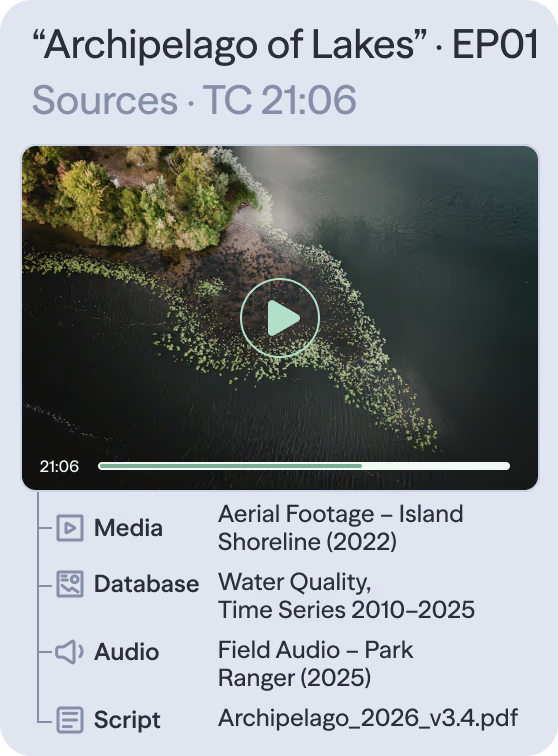
02
Proving Sources and Dependencies
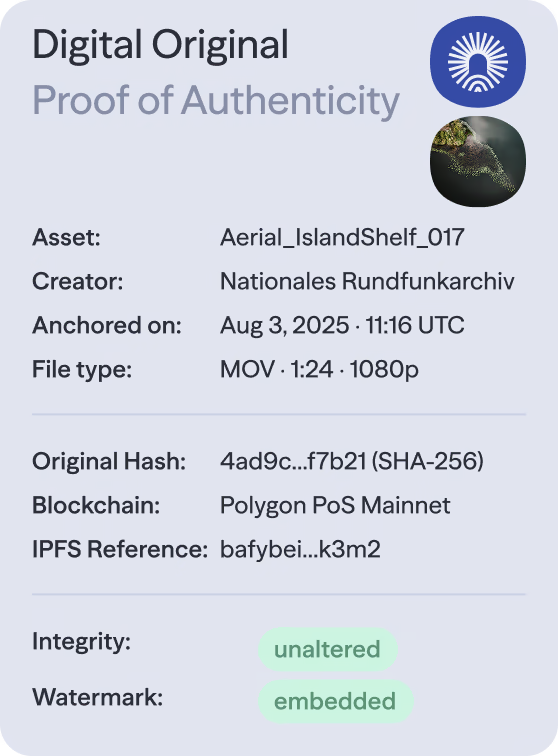
03
Documenting & Protecting Authenticity

04
Control & Monetize Usage
• Der Weg vom Archiv zur Beweiskette
So funktioniert’s
AnwenderInnen
Für wen nachweisbare Archive entscheidend sind
• Use Cases
on:mint makes these archives and datasets verifiable
Media & Corporate Archives
Research & Measurement Data
Government & Administrative Records
AI Training & Data Spaces
Corporate & Product Data
Cultural Collections & Archives
• BEFORE / AFTER
Control instead of loss of control
• Next step
Protect Your Assets
FAQs
What is the on:mint Archive Anchor and what is it used for?
The on:mint Archive Anchor is a B2B product designed to ensure the integrity of large digital archives, particularly historical media collections.
It enables organizations to document the state of entire archives at a specific point in time and to verify any subsequent changes in a tamper-proof manner.
The Archive Anchor does not replace existing archive or storage systems.
Instead, it complements them with a technical integrity and trust layer that operates independently of the underlying archive system.
The product is aimed at organizations that want to strengthen and prove the authenticity and integrity of their archival holdings.
Do we need to install software to use the Archive Anchor?
Yes. To operate the Archive Anchor, we install an on:mint software component within the customer’s infrastructure.
This software is the technical prerequisite that enables on:mint to implement the Archive Anchor in the customer environment.
It allows large and distributed archive holdings to be securely connected, synchronized, and integrated into the on:mint integrity framework.
Specifically, the software ensures that:
- on:mint functionality operates directly where the archive data resides
- IPFS-based mechanisms can be used within the customer environment
- integrity checks and state comparisons are performed efficiently and in an audit-ready manner
All archive data remains under the customer’s full data sovereignty.
Via the on:mint API and the installed software, a consistent and verifiable reference state of the archive is created. In practical terms, this functions as a digital twin. Access rights, visibility, and operational decisions remain entirely with the customer.
How does on:mint ensure the integrity and traceability of entire archives?
The Archive Anchor combines multiple technical methods that have proven effective in large-scale media archives:
- cryptographic hashes for the unique identification of each archive file
- versioning logic to make structural and content-related changes traceable
- perceptual hashing to detect content manipulation, especially in image and video material, such as edits, cropping, or subtle alterations
In addition, selected states or events are externally confirmed using immutable timestamps.
This makes it possible to prove that a specific archive state existed at a specific point in time, without disclosing the content itself.
Is the Archive Anchor a special type of backup solution?
Yes. The Archive Anchor is a specialized form of backup solution in which all content remains private and access-restricted.
Archive holdings are redundantly stored and secured via our gated IPFS system, without becoming publicly visible or relinquishing control over sensitive data.
The decentralized structure eliminates a single point of failure. Archive data is distributed and protected against outages, without dependence on a central system. In this way, the Archive Anchor also acts as an additional IT security mechanism.
Building on this, the on:mint Archive Anchor goes one step further by combining backup functionality with a robust proof of integrity.
Through IPFS-based synchronization, a digital twin of the archive is created that fully and consistently reflects the original state of the holdings.
This twin serves not only as a backup, but as a technical reference for integrity and authenticity. Any deviation between the archive and the reference state becomes clearly and traceably detectable.
As a result, the Archive Anchor answers questions beyond traditional backup use cases:
- whether archive holdings have changed since a specific point in time
- whether content remains authentic and unaltered
- whether the state of an archive can be credibly demonstrated to third parties
The Archive Anchor therefore functions as an independent data integrity layer that safeguards the authenticity and immutability of archival holdings.
What concrete benefits does the Archive Anchor provide for media archives?
The Archive Anchor establishes a robust technical foundation for trust in large media collections.
Typical use cases include:
- safeguarding the authenticity of historical content
- supporting licensing and monetization processes
- reducing risk in disputes related to manipulation or authenticity
- preparing archives for controlled reuse, for example in analytics or AI contexts
The Archive Anchor makes archives technically verifiable and permanently integrity-secured by ensuring data integrity, resistance to manipulation, and traceability across large media holdings. This is achieved without making content public or altering existing archive systems.