



1,000 Copies. Zero proof.

Your work is drifting everywhere
AI helps itself without asking

Talent alone won’t cut it anymore
on:mint delivers exactly that.
Cryptographic Watermarks
Case Study: From Origin to Impact
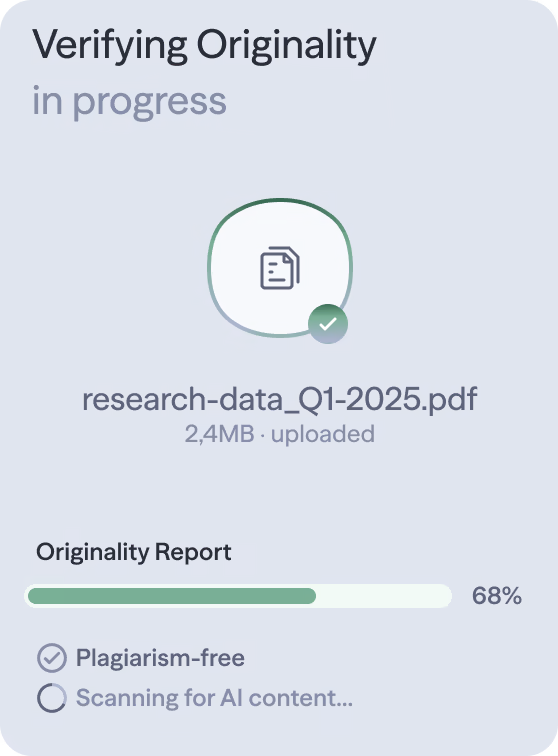
01
Upload & Reality Check
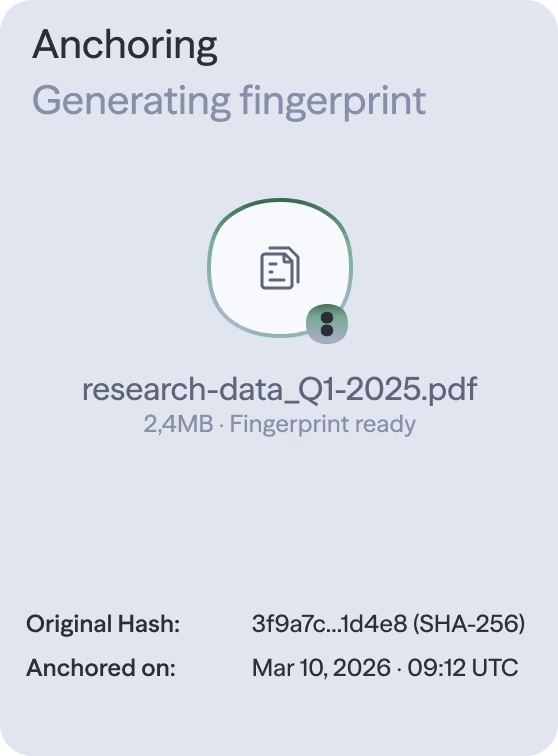
02
Fingerprint & Blockchain Anchor
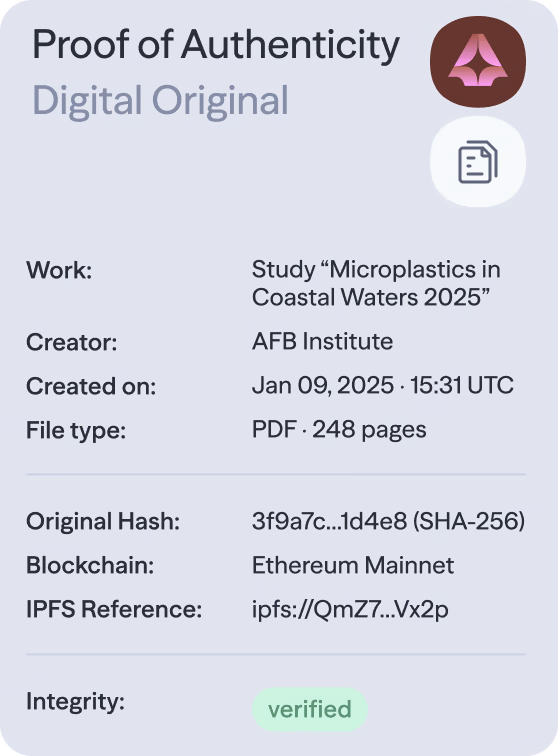
03
Verify & Share
04
Certificates & Verification
• Anwendungen
Für wen digitale Wasserzeichen den Unterschied machen
• Der Weg zum Original
So funktioniert’s
• Use Cases
Making your content unmistakable
Photography & Campaign Imagery
Music & Sound Design
Copy & Journalism
Graphics & Design
Video & Motion
Data & Research
Engineering & Blueprints
• Before / After
Control instead of loss of control
• NEXT STEP
Protect what's yours
FAQs
What is the on:mint watermark – and why is it more than a traditional digital watermark?
The on:mint watermark is neither a visible overlay nor a modifiable metadata tag. It is a cryptographically secured proof of provenance for digital originals.
It provides verifiable evidence of origin, timestamp, and integrity – permanent and tamper-proof.
The digital asset itself is stored and protected in a restricted-access, EU-hosted IPFS system.
IPFS identifies files via their unique cryptographic fingerprint. Any modification automatically creates a new version and is immediately detectable.
In parallel, the proof of authenticity is additionally anchored on a public blockchain (e.g., Polygon). This second layer creates an independent, globally verifiable proof of time and integrity.
The on:mint Blockchain Explorer presents this information in a form that is understandable and usable for legal and commercial contexts. Unlike conventional blockchain explorers, on:mint translates technical transactions into clear, human-readable proofs of origin and integrity.
The rights holder remains in full control and decides which information is publicly visible – the asset itself stays protected.
The key difference: The work itself is not marked. Its authenticity is made provable.
The credentials and records visible in the Explorer constitute the actual watermark or certificate of authenticity: permanent, controllable, non-removable, and independently verifiable.
How does on:mint help in dealing with AI-generated content and “AI slop”?
The EU AI Act focuses on labeling AI-generated content, particularly deepfakes. on:mint complements this approach by addressing the economically decisive counterpart:
Instead of marking AI-generated content, on:mint protects the original – making digital works that claim copyright-relevant originality clearly and provably identifiable.
In legal proceedings, the owner of a digital original can present an authenticity proof via the credentials documented in the Blockchain Explorer. The transaction history provides immutable evidence of origin, integrity, and timestamp.
The associated Explorer link can easily be embedded or combined with the digital asset. This creates a permanently verifiable Proof of Authenticity, giving the original a clear technical distinction – even in an environment saturated with “AI slop.”
Who can see my assets – and how is confidential content protected?
The digital assets themselves are not publicly accessible. They are securely stored in a token-gated IPFS system hosted on EU infrastructure (Scaleway, IONOS).
Only the authorized rights holder controls access.
What is publicly visible is only the proof of provenance:
The on:mint Blockchain Explorer shows that a digital original exists, when it was registered, how versions evolved, and which integrity checks were performed – without exposing the asset itself.
This resolves a core tension:
Maximum transparency for legal certainty, combined with maximum confidentiality of content.
How robust is the proof?
on:mint combines multiple layers of evidence:
- Identity verification (KYC) of the submitting party
- IP-forensic analysis to detect AI-generated components
- A documented provenance chain maintained by the creator
- Blockchain-based timestamping and immutability
- Version security through IPFS content addressing
The result is not a single data point, but a coherent evidentiary framework that goes far beyond traditional metadata or platform-based solutions.
In an environment of increasing AI proliferation, this combination becomes a decisive foundation for trust, enforceability, and economic value creation.
How do I use the proof of provenance?
The proof can be used seamlessly and without media breaks:
- Embedding the IPFS link or Blockchain Explorer reference on websites, portfolios, or in contractual documents
- Linking with social media platforms (integrations in progress)
- Use in licensing negotiations or legal disputes
A single click is enough: the recipient sees – clearly presented – whether the asset is a digital original, how its value chain looks, and whether manipulation can be ruled out.
This addresses a key future factor: The origin and integrity of digital assets become a competitive advantage. Those who can credibly secure digital value create trust – in markets, in AI systems, and in legal contexts.
Can I protect all types of digital assets with on:mint?
on:mint is fundamentally designed to secure digital assets of any kind with a tamper-proof proof of provenance.
Full support for music and video formats will be available by the end of March 2026. The technical implementations are currently in their final stages.
Regardless of file type, one principle applies:
on:mint does not protect the format – it protects the authenticity, origin, and integrity of the digital original, creating a unified foundation for trust, monetization, and legal enforceability.